
In wholesale, your customers can place their own orders.
For wholesalers and distributors in Greece, we set up a B2B eshop with per-customer prices, a warehouse that works by scanning, and invoices sent through a licensed provider, on Odoo or connected to the software you use today. The warehouse sees at once what to pick, nobody types orders in a second time, and delivery notes are ready for Phase B1, the next stage of Greece's digital delivery notes.
A DAY IN A WHOLESALE WAREHOUSE
Four things that spoil the day in a wholesale warehouse, and what changes when the B2B eshop, the warehouse and the paperwork run on one system.
Orders by Viber, by email, on a scrap of paper and in missed calls Orders from everywhere
Phone, email, Viber, the sales rep on the road. Someone types them all into the software again, and somewhere along the way a line goes missing or a quantity goes in wrong.
Customers and sales reps order from the B2B eshop, and the warehouse sees it at once.
See one order, step by stepThe eshop product card and the invoice show different prices for the same product The customer sees a different price
Tiered discounts, per-customer prices, this month's offers: they live in your ERP, not on the eshop. When the price on screen doesn't match the invoice, you lose time and customers.
The price on screen is the price on the invoice, for each customer.
A B2B eshop with each customer's pricesAn almost empty warehouse shelf and a phone where the eshop says in stock The stock says something else
The warehouse has 12, the eshop shows 40 and the marketplace says “in stock”. You find out when a customer orders 40.
The warehouse, the eshop and the marketplaces all see the same stock.
A warehouse that works by scanningThree calendar sheets, 2 November, 1 January and 1 February, the last one ringed The documents are changing
B2B e-invoicing from 2 November 2026, loading and receipt on delivery notes from 1 January 2027, invoices only through a provider from 1 February 2027. The software has to be ready, and the warehouse with it.
Delivery notes and invoices come out ready for every date.
What changes in delivery notes
ONE WHOLESALE ORDER, STEP BY STEP
From the customer's phone to the truck and the invoice. Use the switch to see what happens when an order goes over the customer's credit limit.
- The customer
- Odoo
- The warehouse
- Provider
Status and invoice back to the customer
- The customer opens the B2B eshop on their phone, sees their own prices and reorders their usual items in one click.
- Odoo checks the customer's credit limit and reserves the stock.
- The order goes over the credit limit. It isn't rejected: it waits for approval, and the sales manager gets a notification.
- The sales manager approves it from their phone, and the order carries on.
- The warehouse sees what to pick and scans every item as it's picked. The delivery note goes out with its MARK, the number the Greek tax authority gives every document.
- The invoice goes out through the provider, and the MARK comes back to Odoo.
- The customer sees in their account that the order is on its way, together with the invoice.
A B2B ESHOP WITH EACH CUSTOMER'S PRICES
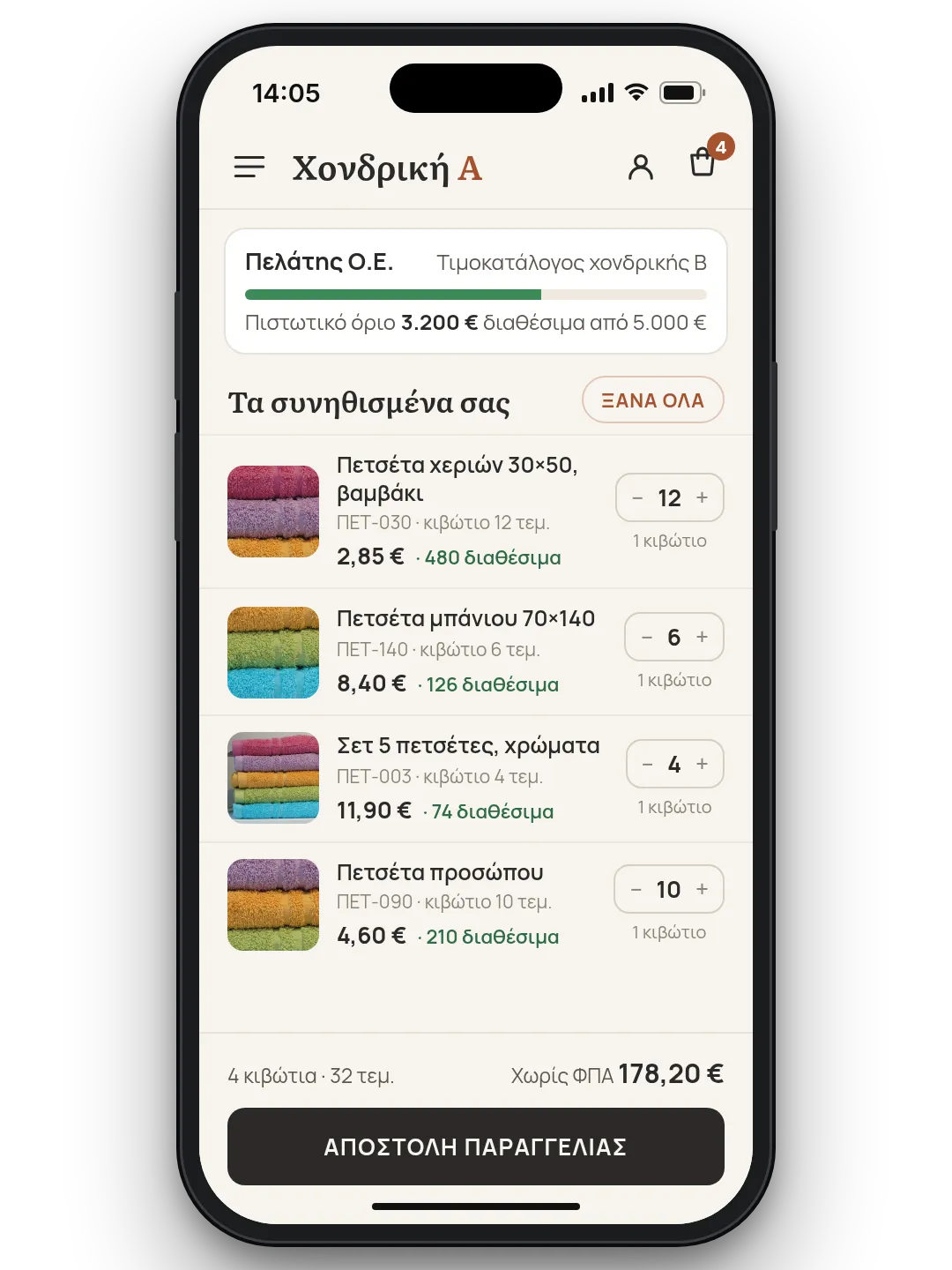
Your customers log in to their account and see their own prices, the stock available and their credit limit. They reorder their usual items in one click and find their invoices there too.
Prices come from your ERP as they are, with tiered discounts and offers. The price the customer sees is the price on the invoice.
If you like, the B2B eshop also becomes an Android app with your logo, on your customer's phone.
A WAREHOUSE THAT WORKS BY SCANNING
The warehouse sees on a phone or a scanner what to pick, in shelf order. Every item is scanned as it's picked, so no wrong product code leaves, and a product can be found by any of its barcodes.
If you have several warehouses, each order goes to the one that has the stock. Stock counts are done with the phone's camera, shelf by shelf.
The delivery note goes out with its MARK, and from 1 January 2027 loading and receipt are recorded too, as Phase B1 of Greece's digital delivery notes requires.
Odoo · Order picking
WH/OUT/04388
Order S02417 · 14 lines · shelves A to D
- Detergent 4 l24 / 24
- Kitchen roll, 6 pack40 / 40
- Bin bags, 50 pcs6 / 12The other 6 from Warehouse 2
- Nitrile gloves, M30 / 30
READY TO LOAD
ONE CLEAN CATALOGUE FROM ALL YOUR SUPPLIERS
Every supplier sends its catalogue differently: Excel, XML or a link to its own system. We merge them into one clean catalogue, with EAN codes, manufacturer codes, attributes, photos and descriptions, updated automatically every day. See how we set up supplier XML feeds.
This is how the catalogues of several wholesale suppliers become one (see the five traps of supplier XML imports). Anything missing, such as a description or a category, is filled in by AI and checked by a person.
You'll need the same catalogue for the EU's Combined Nomenclature (CN) product codes, which go on Greek delivery notes from 1 January 2028.
- Suppliers to Catalogue: EAN and manufacturer codes
- Suppliers to Catalogue: attributes
- Suppliers to Catalogue: photos and descriptions
- Suppliers to Catalogue: purchase prices
- Suppliers to Catalogue: availability
SERVICES FOR YOUR WHOLESALE BUSINESS
We also take on each piece on its own. See how we set it up:
Eshop–ERP integration
Prices, stock and orders update by themselves between the eshop and your ERP.
Odoo Greece
If the software you have holds you back, Odoo set up for a company in Greece.
Digital delivery notes
Loading, transhipment and receipt by scanning, for Phase B1 from 1 January 2027.
Greek e-invoicing
Your software connected to a licensed provider before 31 January 2027.
AI automation
Supplier invoices that become purchase lines, and descriptions for thousands of products.
Marketplaces & XML feeds
The same stock and the same prices on every marketplace you sell on.
HOW WE SET UP ODOO FOR WHOLESALE WITHOUT STOPPING THE WAREHOUSE
Mapping
About a week: where orders come from, which price lists apply, how the warehouse works, which documents you issue.
Connection map
We write down with you which system has the last word on prices, stock and customers, and what happens when they disagree.
Pilot
Five to ten customers order from the B2B eshop while the warehouse works as usual.
All customers
We open the B2B eshop to everyone and add the mobile app and the automations you need.
QUESTIONS
Will I need to change my ERP?
Not necessarily. We connect the B2B eshop and the warehouse to the software you use today, if it has an API or a database we can read. If it holds you back, we show you how the same would work in Odoo.
Which system has the last word on prices and stock?
Usually your ERP. We write it into the connection map before we start, together with what happens when two systems disagree.
How do my customers get into the B2B eshop?
By invitation from you. Their account is linked to their record in your software, so from day one they see their own prices and their balance.
Can our sales reps take orders on the road?
Yes. Sales reps log in with their own account and order on the customer's behalf, at the customer's prices. The order reaches the warehouse like any other.
Is there a mobile app?
Yes. The B2B eshop also becomes an Android app with your logo.
What happens if the connection drops?
No order is lost. It waits and goes into your software as soon as the connection is back, exactly once.
Are we ready for Phase B1 of the delivery notes?
We check during the mapping and give you a list of anything missing. See what changes from 1 January 2027.
Can you work in English with our group's team?
Yes. Proposals, the connection map and handover notes are in English or Greek, and we talk to your Greek warehouse and accountant in Greek.
How much does it cost?
After the mapping you know what will be set up and we write you a fixed price, with no small print.
TELL US HOW ORDERS REACH YOU TODAY.
Two lines are enough.