
With a retail eshop and a shop, you sell everywhere from the same stock and the same price list.
We set up Odoo as the ERP for your retail eshop, so you sell through your eshop, the marketplaces and your physical shop from one stock and one price list. Orders from everywhere arrive on one screen, receipts and invoices go out through a licensed provider, and the courier voucher comes straight from the order.
Eshop
- Price list
- Retail · €64.90
- Available
- 6 pairs
Skroutz
- Price list
- Retail · €64.90
- Available
- 6 pairs
Shop
- Price list
- Retail · €64.90
- On the shelf
- 2 of the 6
A DAY IN A SHOP WITH AN ESHOP
Four things that spoil the day in a shop with an eshop, and what changes when the shop, the eshop and the marketplaces run on one system.
A receipt for the last pair and a new eshop order for the same pair The same pair sold twice
The last pair sold in the shop in the morning. The eshop and Skroutz, Greece's best-known marketplace, showed it as available until the afternoon, when a customer ordered it online. Now someone has to phone them to cancel.
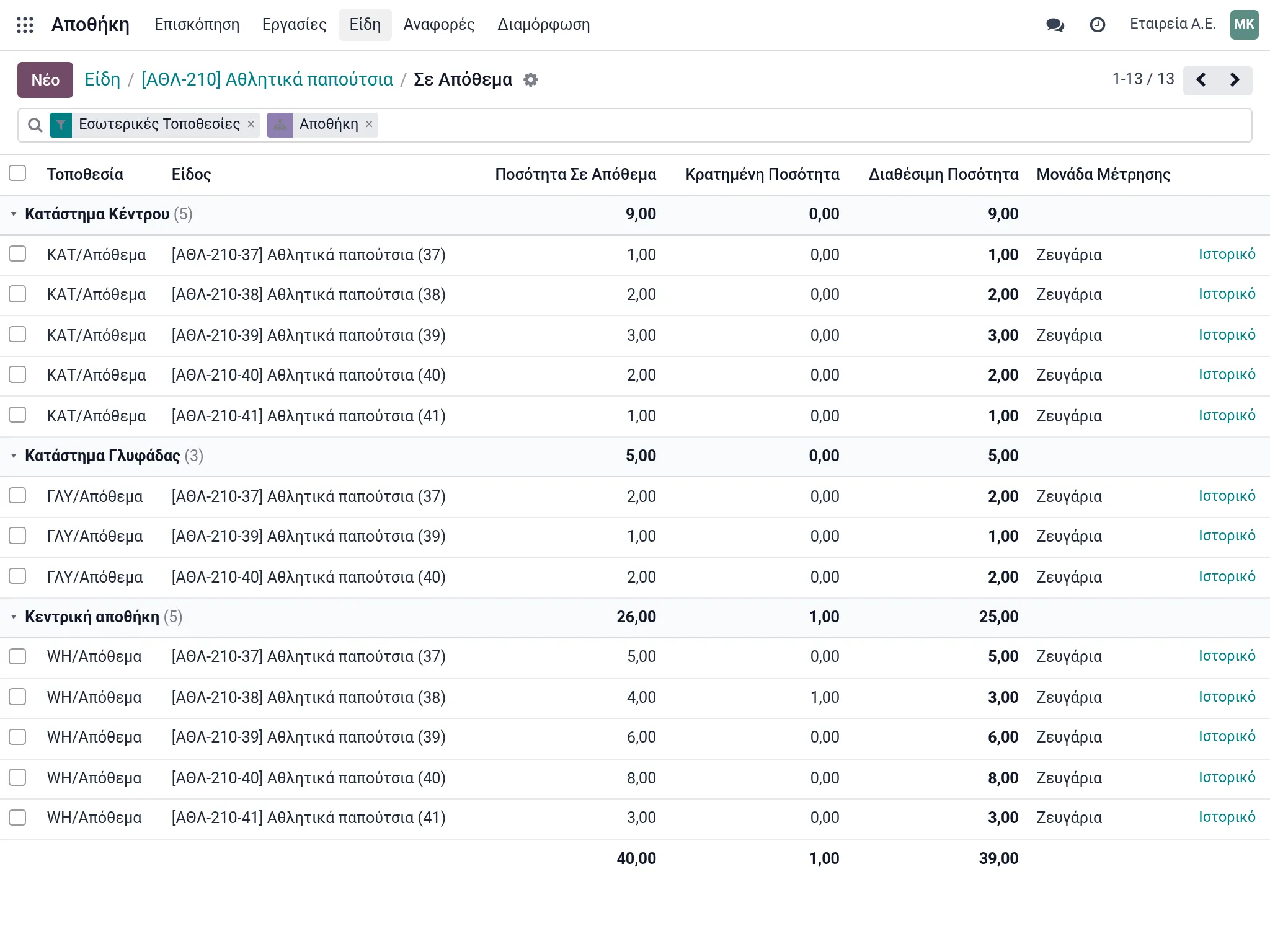
The shop, the eshop and the marketplaces all sell from the same stock.
The shop on the same stockOne price on the eshop and another on the shelf label One price on the shelf, another on the eshop
The offer went into the shop's till but was forgotten on the eshop, or the other way round. The customer who saw the price online comes to the shop and asks for the same.
Prices and offers change in one place and arrive the same everywhere.
Prices and offers from one placeOrders from a marketplace, the eshop and the phone in three different places Orders on three screens
Eshop orders show in the eshop's admin, Skroutz orders in its own back office and phone orders in a notebook. Someone types them one by one into the business software so the receipt can be issued.
All orders land in the same software, with nobody typing them again.
One eshop order, step by stepAn eshop checkout where the company asks for an invoice in the notes The customer asks for an invoice
A company buys from the eshop and enters a VAT number. Invoices to businesses are electronic from 2 November 2026, and from 1 February 2027 they go only through a provider or the Greek tax authority's own apps. The eshop has to know when to issue a receipt and when an invoice.
The eshop knows when it's a receipt and when an invoice, and sends it through the provider.
Receipts and invoices through the provider
ONE ESHOP ORDER, STEP BY STEP
From the customer's phone to the parcel and the receipt. Use the switch to see what happens when the same pair has just sold in the shop.
- The eshop
- Odoo
- Provider
- Courier
Receipt and tracking number back to the customer
- A customer orders trainers, size 38, on her phone and pays by card.
- The order goes into Odoo, next to those from Skroutz and the shop. The pair is reserved, and the available stock drops from 6 to 5 on the eshop, on Skroutz and at the till.
- The size 38 on the shelf sold at the shop's till a minute earlier. Odoo doesn't reserve it twice: it finds a pair in the warehouse and sends the order there.
- Available stock updates everywhere within seconds, so nobody else buys something that isn't there.
- The receipt is issued in Odoo and goes out through the provider, which returns the MARK, the number the tax authority gives every document.
- The courier voucher comes from the order, and the tracking number goes to the eshop.
- The customer gets an email with the receipt and the tracking number, and the available stock is right on every channel.
THE SHOP ON THE SAME STOCK AS THE ESHOP
Every sale at the shop's till lowers, within seconds, the stock that the eshop and the marketplaces show. During the mapping we decide together whether the till moves to Odoo or the one you have today stays, connected to Odoo. Either way it sells from the same stock.
A customer orders online and collects in the shop, or brings back to the shop something bought online. Both show on the same order, and the stock moves by itself.
Stock counts are done with the phone's camera, shelf by shelf, without closing the shop. If you have two shops or a warehouse, you see where every item is.
PRICES AND OFFERS FROM ONE PLACE
Prices change in one place, the price list in Odoo, and arrive the same on the eshop, the marketplaces and the shop's till. If you want a different price on a marketplace, to cover its commission, we set it as a rule, not by hand.
Offers go in with a start and an end date. Odoo keeps the history of every price, so next to every reduction the right previous price shows: the lowest of the 30 days before, as art. 9i of Greek law 2251/1994 requires.
For one of your products, try the previous price calculator.
Previous price: €69.90Sale 24 Oct: €59.90
RECEIPTS AND INVOICES THROUGH THE PROVIDER
Every order, whichever channel it comes from, becomes a receipt or an invoice in Odoo and goes out through the e-invoicing provider. The MARK (the number AADE, the Greek tax authority, gives every document) comes back to Odoo, and the customer gets the document by email.
When a customer enters a VAT number at the eshop's checkout, an invoice is issued instead of a receipt, once their details are checked. Invoices to businesses are electronic from 2 November 2026, and from 1 February 2027 they go only through a provider or AADE's own apps. See what changes in Greek e-invoicing.
In the shop you can keep your cash register. The card terminal (POS) connects to the cash register or to the provider's software, as decision A.1155/2023 on POS interconnection requires.
- Eshop, marketplaces, shopthe order
- Odooreceipt or invoice, with a VAT-number check
- Providerlicensed by AADE
- myDATAissues the MARK
The MARK back to Odoo, the document to the customer
COURIERS AND RETURNS
The courier voucher comes from the order itself, without anyone typing the address and phone number again. The tracking number goes to the eshop, and the customer gets an email to follow the parcel.
When a customer sends something back, the return is scanned on arrival. Whatever is in order goes back into the stock of every channel, the credit note goes out through the provider, and the money is refunded within 14 days, as the law on withdrawal requires.
Since July 2026 the eshop also needs a withdrawal button. See what else the new rules ask of an eshop.
Odoo · Return check
RET/00418
Order #20377 · withdrawal on 16 Oct
- Trainers, 381 / 1
- Socks, 3 pairs1 / 1
- Rain jacket, M0 / 1Not in the parcel: we ask the customer before the credit note
CREDIT NOTE AND REFUND
WHAT THE RULES ASK OF A RETAIL ESHOP TODAY
When you sell online to consumers in Greece, the eshop needs four things it didn't need a few years ago.
Withdrawal button
A «Πατήστε εδώ για υπαναχώρηση» (“click here to withdraw”) button, a form, a separate «Επιβεβαίωση υπαναχώρησης» (“confirm withdrawal”) button and an acknowledgement to the customer straight away, with date and time.
Previous price in sales
Next to every reduction, the lowest price of the 30 days before, not the “original” price and not the recommended retail price.
Cookies with “Reject”
No analytics or advertising cookies before the visitor says yes, and “Reject” with the same number of clicks and in the same place as “Accept”.
Accessibility
A basket and checkout that work with a keyboard and with a screen reader, from 28 June 2025. Micro-enterprises are exempt.
We check them and fix them on the eshop you already have. See eshop compliance with the new rules.
SERVICES FOR YOUR RETAIL ESHOP
We also take on each piece on its own. See how we set it up:
Eshop development
WooCommerce eshops with a Greek checkout, couriers, documents through a provider and your stock connected from day one.
Odoo & WooCommerce
Prices per store, stock per warehouse and orders, in both directions.
Marketplaces & XML feeds
Skroutz, BestPrice, Shopflix and Public with the same stock and the same prices as your eshop.
Eshop compliance
Withdrawal button, cookies, accessibility and the previous price, on the eshop you have.
Google Ads & sales tracking
Google advertising with proper tracking, so you know which ad brought which sale.
Greek e-invoicing
Invoices and receipts through a licensed provider, before 31 January 2027.
HOW WE SET UP THE ERP FOR A RETAIL ESHOP WITHOUT CLOSING THE SHOP
Mapping
About a week: where orders come from, how you issue receipts in the shop and on the eshop, where you keep stock and how returns work.
Connection map
We write down with you which system has the last word on prices, stock and customers, and whether the shop's till moves to Odoo or the one you have stays.
The eshop first
We connect the eshop and the marketplaces to Odoo while the shop works as usual. We count the stock with a phone, so everything starts from the right numbers.
Then the shop
We connect the shop's till to the same stock, and we're with you for the first days.
QUESTIONS
Will I need to change my eshop?
No. We connect the eshop you have, on WooCommerce or Shopify, to Odoo. If the eshop needs rebuilding anyway, we rebuild it, connected from the start. If you're still choosing a platform, see the guide WooCommerce or Shopify.
Will I need to change my business software?
Not necessarily. If the software you use today has an API or a database we can read, we connect the eshop and the marketplaces to it. If it holds you back, we show you how the same would work in Odoo, and move you to it step by step.
Can I keep my cash register?
Yes. If your till is software connected to a cash register, we connect its sales to the stock in Odoo, and receipts keep coming from the cash register.
Can I have one price on Skroutz and another on the eshop?
Yes. The marketplace price comes from the same price list through a rule, for example to cover the commission, and changes by itself when the base price changes.
What if the same item sells on two channels at the same time?
Odoo reserves the stock with the first order and updates the other channels within seconds. If a second order still gets in, you see it before the parcel is packed, and Odoo looks for the item in another warehouse or shop. See it in one order's journey.
A customer asks for an invoice. What changes?
At the eshop's checkout the customer chooses a receipt or an invoice and enters their VAT number, which is checked before the invoice is issued. The invoice goes out as an e-invoice through the provider, and from 1 February 2027 only that way or through AADE's own apps. See what changes on 1 February.
How do returns work?
The customer declares the withdrawal with the eshop's button, the return is scanned when it arrives, and the credit note is issued from the same order. Whatever is in order goes back into the stock of every channel.
Can you work with us in English?
Yes. Proposals, the connection map and handover notes are in English or Greek, and we talk to your Greek accountant in Greek.
How much does it cost?
After the mapping you get a written proposal with a fixed price, with no small print.
TELL US WHERE YOU SELL TODAY.
Two lines are enough: eshop, marketplaces, shop, and which software you use.