
Product data written by AI for thousands of products, only from facts that check out.
AI product data entry saves you months of work: AI writes titles, attributes, categories and descriptions for your products, in Greek and English, only from verified data such as the EAN, the spec sheet and the supplier's catalogue. What it can't find there it leaves empty and flags for a person, and nothing reaches your eshop or the marketplaces unchecked.
ΒΡΑΣΤ. ACME KT17 INOX 1,7LT 2200W ΜΑΥΡ.
- EAN 5207654321016
- Spec sheet, 2 pages
Your catalogue · new productTo approve
- Titlepasses the checkAcme KT17 kettle, 1.7 L, 2200 W, stainless steel, blackfrom the title and the spec sheet
- Categorypasses the checkSmall kitchen appliances › Kettlesfrom your own categories
- Capacity · Powerpasses the check1.7 L · 2200 Wspec sheet, page 1
- Materialpasses the checkStainless steelspec sheet, page 1
- Cord lengthneeds a person to checkNot in the spec sheet. Left empty for a person.
Written with AI · waiting for a person to check
WHERE PRODUCT DATA ENTRY BREAKS DOWN ON AN ESHOP
A supplier catalogue with abbreviated titles and no description Thousands of products, written the way the supplier writes them
Greek suppliers send titles like «ΒΡΑΣΤ. ACME KT17 INOX 1,7LT», in capitals and abbreviations, with no description. Someone has to rewrite them one by one, in Greek, before they can go on the eshop.
The AI writes clean titles and descriptions for thousands of products, and you check them.
One new product, step by stepThe same attribute written three ways by three suppliers Filters that hide half your products
One supplier writes «Inox», another «ανοξείδωτο» (stainless), a third «ΑΝΟΞ. 18/10». Capacity is «1,7LT» or «1700 ml». A customer filters for stainless steel and sees half of what you sell.
Every attribute is written the same way, so filters show every product.
A product description that claims something untrue A description that says something untrue
An AI tool left to write freely adds whatever sounds right: “quiet”, “with a limescale filter”. The customer reads it, buys the product and sends it back.
Descriptions are written only from the product's own data, and you know what the AI wrote.
You always know what the AI wroteThree calendar sheets up to 1 January 2028, the last one ringed Item codes for the 2028 delivery notes
From 1 January 2028, every item on a Greek delivery note will carry its Combined Nomenclature code. Matching thousands of products by hand takes weeks.
For each item, a suggested Combined Nomenclature code. Anything uncertain goes to you.
Item codes for the 2028 delivery notes
PRODUCT TITLES, ATTRIBUTES AND DESCRIPTIONS BY AI
The AI writes only from data whose source we can show. It's one of the AI automations we set up.
Titles the way the marketplaces want them
Clean titles with the manufacturer, the model and whatever sets the product apart, the way the marketplaces ask for them. No capitals, abbreviations or “special offer” in the title.
Attributes in one consistent form
Each attribute is written the same way across the catalogue, with the same units. That way the eshop's filters work, and so do the attribute fields the marketplaces now accept.
Categories where customers look
Each product goes into one of your own categories, based on its title, attributes and photo. It runs as a dry run first, and you see what would change before it does.
Product descriptions in proper Greek
Descriptions in proper Greek, and in English if you sell abroad, written only from the product's own data. Every number in a description is in the spec sheet.
Photos in one consistent style
A clean background and the same framing for all of them, at 1200×1200, a size the marketplaces accept. The originals are kept, and no eshop address (URL) changes.
Item codes for delivery notes
For each item, a suggested Combined Nomenclature code for Phase B2 of Greek delivery notes, from 1 January 2028. A person checks any that aren't certain.
WHERE EACH FIELD COMES FROM
The AI doesn't write everything. What the supplier provides we keep as it is, and the AI takes on only what needs writing or tidying.
Scroll sideways to see all columns
| Field | Comes from | What the AI does | Who checks |
|---|---|---|---|
| EAN, MPN, manufacturer | The supplier | Nothing; the EAN is only checked for validity | An automatic check |
| Title | The supplier's title and the spec sheet | Rewrites it with the manufacturer, the model and what sets the product apart | All of them at first, then samples |
| Attributes | The spec sheet | Brings them into one form and one set of units; anything missing stays empty | Anything flagged |
| Category | Your own categories | Suggests one, from the text and the photo | A dry run, before anything changes |
| Description | Only the fields above | Writes it; every number must be in the data | A person, before it's published |
| Photos | The supplier's or your own | Clean background, same framing, 1200×1200 | The originals are kept for rollback |
| Combined Nomenclature code | The description and the attributes | Suggests the eight-digit code, with its reasoning | A person, for any that aren't certain |
Every field keeps its mark: where it came from, whether AI wrote it and who approved it.
ONE NEW PRODUCT, FROM THE SUPPLIER TO THE ESHOP
A new product's journey, step by step. Use the switch to see what happens when the supplier's data contradicts itself.
- The supplier
- The AI
- The check
- Eshop & marketplaces
- A new product appears in the supplier's XML feed, «ΒΡΑΣΤ. ACME KT17 INOX 1,7LT 2200W ΜΑΥΡ.» (a kettle), with an EAN and a PDF spec sheet.
- The AI reads the spec sheet and writes a title, seven attributes, a category and a description, in Greek and English. For each fact it records where in the spec sheet it came from.
- The check finds every number and attribute in the spec sheet: 1.7 L, 2200 W, stainless steel. The AI added nothing of its own.
- The catalogue manager reads the record and approves it. The product gets the mark “AI, checked”.
- The supplier's title says 2200 W, but the spec sheet says 2000 W. The AI doesn't pick one: the power field stays empty and the product is flagged.
- The catalogue manager sees both values side by side, asks the supplier and enters the right one, 2000 W. The correction sticks: the supplier's next update doesn't overwrite it.
- The product goes live on the eshop and into the feeds for Skroutz and BestPrice. In the feed for Google Shopping, the title and description are declared as written with AI, as Google asks.
ITEM CODES FOR THE 2028 DELIVERY NOTES
From 1 January 2028, Phase B2 of Greece's digital delivery notes begins: every item will carry its Combined Nomenclature code, the eight-digit EU code that customs also use.
The code comes from the same facts the product listing needs: what the product is, what it's made of, what it's for. So the AI suggests it alongside the other fields, with its reasoning, a person checks any that aren't certain, and the code goes onto the item's record in Odoo.
What changes on delivery notes from 1 January 2027 is on our digital delivery notes page.
- Product factswhat it is, material, use
- AI suggestioneight-digit code, with reasoning
- A person checksany that aren't certain
- Item recordin Odoo, ready for delivery notes
YOU ALWAYS KNOW WHAT THE AI WROTE
Every field the AI wrote carries a mark in the catalogue: which data it came from, when it was written and who approved it. You always know what the AI wrote and what a person wrote.
What the AI writes is kept apart from the supplier's data and never overwrites it. If you don't like a text, you go back to the previous one in one click.
The mark also goes out where it's asked for. Google, for example, wants titles and descriptions written with AI in their own fields in Merchant Center, marked as AI-generated, and the feed for Google sends them that way.
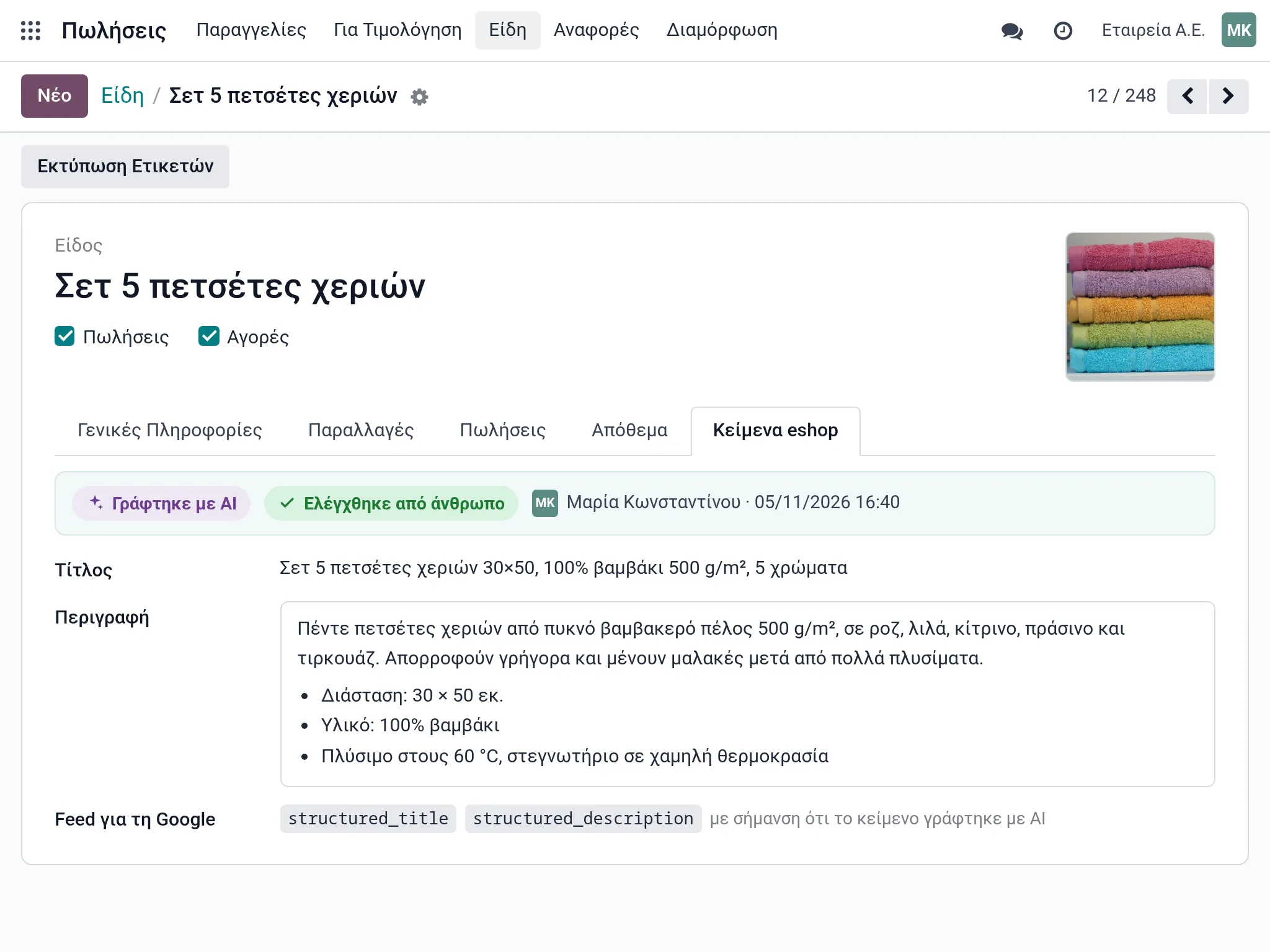
AI PRODUCT DATA FOR THOUSANDS OF PRODUCTS, READY TO SELL
Instead of someone keying in products for months, AI handles product data entry across thousands of codes and you approve the result.
Supplier files, turned into finished products
Files go in as they are and come out as clean products with their variants. AI writes the texts in every language you sell in and finds the categories, and the supplier's own data stays untouched beside them.
The right category, from the title and the photo
AI reads the title and the photo and puts each product where your customer will look for it. It works in batches and shows you first what would change.
Consistent product photos, without closing the eshop
A clean background and the same framing at 1200×1200, and your eshop gets a new look. The new photos replace the old ones without changing a single address, and the originals are kept for rollback.
Product descriptions that don't make things up
One role writes, a second corrects the Greek, and a third checks every fact against the source. Anything not in the data is rejected before a customer sees it.
How many products are waiting to go online? Tell us and we'll propose how to get them there.
HOW PRODUCT DATA ENTRY WORKS, FROM SAMPLE TO ESHOP
As a rough guide, for a catalogue of a few thousand products:
A sample of 100 products
Week 1. Together we pick 100 products across different categories and suppliers. We agree how you want the titles, which attributes each category needs and how they're written.
Testing the rules
Week 2. The AI writes the sample and you read it. We adjust the rules and instructions until the result is what you would have written yourself.
The whole catalogue, as a dry run
Week 3. The AI runs across the whole catalogue without changing anything on the eshop. You see what would change and what was flagged for a check.
Publishing, and new products
Week 4. Whatever was approved is published. From then on, every new product from your suppliers takes the same route.
QUESTIONS
How does AI product data entry work?
AI writes titles, attributes, categories and descriptions only from verified data: the EAN, the spec sheet and the supplier's catalogue. What it can't find there it leaves empty and flags for a person. Every field the AI wrote carries its mark, and goes to the eshop, the marketplaces and Odoo only after a check.
Does the AI make things up?
It can when it writes freely, which is why here it doesn't. Every number and attribute must be in the supplier's data; otherwise the field stays empty and is flagged. Everything published has been seen by a person.
Can it write proper Greek if nobody on our team does?
Yes. Greek is the harder language for AI, so we test the models on Greek and use the one that writes it best for each job. If nobody on your team reads Greek, we can do the check on the Greek texts for you, and you approve the English ones.
Will all the descriptions sound the same?
No. Each description is written from its own product's data, with the style rules we agree for each category. Two kettles look alike, but they don't have the same capacity, power and material.
Will AI-written texts hurt my Google rankings?
Google asks for AI-written content to be checked by a person for accuracy before it's published, and treats lots of pages made without adding anything for visitors as abuse. That's why every description is written from its own product's data and checked before it goes live.
Do I have to say that a description was written with AI?
For Google Shopping, yes: Merchant Center wants titles and descriptions written with AI in their own fields, marked as such. Since every field already carries its mark in the catalogue, the feed for Google sends it along.
Does it work with WooCommerce, Shopify or Odoo?
Yes. Approved records go to the eshop and to Odoo, or into a file ready to import into the software you use today. If your products come from several suppliers, see first how we merge them into one catalogue, in supplier XML feeds.
How much does it cost?
It depends on how many products you have and which fields you need. With a sample of your catalogue, we write you a fixed price before we start.
RELATED SERVICES
AI automation
Supplier invoices into Odoo, a chatbot that answers from your documents, and more routine work, checked by a person.
Supplier XML feeds
All your suppliers' catalogues in one, for your eshop, the marketplaces and Odoo.
Digital delivery notes
Loading and receipt with scanning from 1 January 2027, and the item codes of 2028.
Marketplaces & XML feeds
XML feeds for Skroutz, BestPrice, Shopflix and Public, from the eshop or Odoo.
TELL US HOW MANY PRODUCTS YOU NEED TO LIST.
And how many suppliers they come from. We'll tell you how we'd start.